METAMATERIALS
AR/VR APPLICATION
Dual-format AR and VR trade fair experience for Merck — letting visitors explore molecular innovation in immersive 360° VR and tablet AR formats.
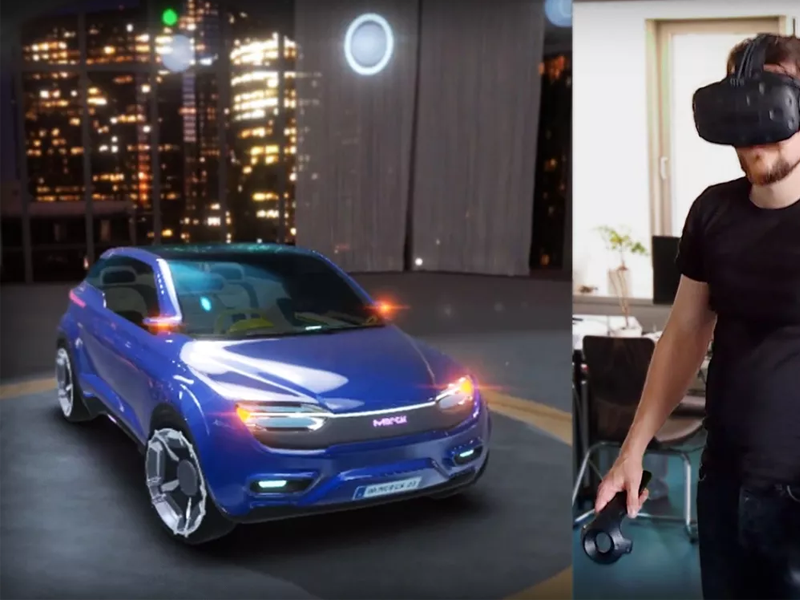
VR Application — HTC Vive
AR Application — Tablet
designmanufacture × Merck Performance Materials
Metamaterials
AR/VR Application
The Challenge
Merck Performance Materials required an interactive application to showcase their advanced metamaterials in a compelling and technically precise way — demonstrating how next-generation surface technologies could transform the appearance and functionality of a vehicle.
THEAFOX realized this project on behalf of the agency designmanufacture for their client Merck Performance Materials.
The materials themselves set extremely high visual demands: photorealistic paint finishes with accurate flake simulation, angle-dependent reflections, and edge-highlighting effects had to be rendered convincingly in real time inside an interactive experience. Achieving this level of realism within Unity 3D required material shaders built with up to 30 nodes in a node-based material editor.
Our Approach
We developed a futuristic concept vehicle as the central showcase object, built around the full spectrum of Merck's metamaterial technologies:
- Antenna structures integrated directly into body surfaces
- Large-area LED coatings used as dynamic vehicle paint
- Flexible, large-format displays integrated into the bodywork
- Electrochromic windows with variable transparency
- Specialty paints that actively highlight vehicle edges and contours
The application was realized in two versions.
VR Application — HTC Vive
The primary experience was a full VR application for the HTC Vive, presented at internal Merck events. Users could explore the vehicle and all its material functions with two methods of interaction:
- An interactive holographic menu that wrapped around the user's hand like a wrist interface
- Information spheres positioned around the vehicle, selectable via pointer ray — each opening detailed information about the respective material or function
Users could switch between day and night environments, activate and deactivate material functions individually, and access background information on each technology — all in real time within the VR space.
AR Application — Tablet
Following the success of the VR experience, a reduced AR version was developed for tablet use. Using marker tracking, the vehicle appeared anchored in the real world — the tablet acting as a window into an augmented space where the full-scale car sat on the marker in front of the user.
Moving physically around the tablet produced a genuine parallax effect, making the car feel spatially present. A streamlined menu allowed users to select which material feature should be displayed as an overlay — all updating on the vehicle in real time.
The Result
A dual-platform interactive showcase that demonstrated Merck's metamaterial portfolio in a way no static presentation or printed material could match — technically precise, photorealistic, and immediately impressive for both technical and non-technical audiences.
This project was developed under strict NDA conditions and used exclusively for internal presentations.
Ready to start your project?
Tell us briefly what needs to be visualized. We'll get back to you with an initial assessment.